Thursday, November 5, 2009

Naive Solution to The Growing Healthcare Problem

The public insurance option won't really work since it doesn't treat the core problem with the system. There is no fair market for goods. The market hasn't found the price for physician services as goods. Whether they are contractors, or employees, or whatever isn't the problem.


The typical solution when a monopoly is overpriced is that a competing firm enters the market to challenge the current cost structure. They may succeed, they may fail, but the change the market, imperceptibly at first, but ultimately they can revolutionize the system. This is currently not possible due to insurmountably high costs of entry. To create a completely new vertically integrated healthcare provider is ridiculously expensive due to the insane legal, legislative and incentive environment. No sane businessman would touch this system, even with its high profitability.

The government is still the solution to the problem, just not by applying a band-aid 1,990 page insurance triage. The current generation of AMA Lobby supporters, physicians, etc... are not going to approve any change to the way the system works. It is just to lucrative for them. In a free market economy, they would be destroyed by their shareholders if they didn't. The only thing left in this particular industry is for the government to directly compete with them.

Instead of aid, legislation, and obscure and complex incentives, allow the government to create an entity that directly recruits Med Students and offers them high salaries, about 30~50% more than the current average being offered by other providers. Even at that salary rate, probably somewhere around $300,000 per year, the costs of running this system would be a minor fraction of the currently allotted 2020 national healthcare bill. The costs would diminish continuously, in much the same way as a normal company's costs diminish as they innovate in efficiency.

Sign the students, and any other professional physicians to long term contracts, between 5 and 10 years. Basically treat them like athletic talent. Take all legal responsibility away from them, take all of the management tasks away from them and give them the ability to just work on the problem, the patient. This focus alone should improve outcomes by 25%. The key to this is to completely ignore the current incumbent provider community, unless they want to work within the system.

Then, within this particular structure, put students directly to real meaningful work with senior students or physicians, not the hazing that happens currently. Provide clear decision support systems that provide recommendations as opposed to CYA legal blah, mandatory treatments and tests. This will help to create some consistency, since you are putting less experienced Doctors in front of patients in some cases, but it will allow stars to shine.

Then, let them innovate, allow them to submit ideas to improving workflows and efficiency and take them seriously. Let these students own, drive, and change the organization. This will go a long way to retaining talent. Secondly on top of their plush salaries, offer them a bonus structure that is tied to what we as a country ultimately want. Solid outcomes at an efficient cost. Give them software tools to easily see the outcome of an individual patient alongside the cost to the system. Quarterly provide meaningful bonuses for improvements in either efficiency or outcomes. These two things should be equal. This will facilitate a dynamic environment that is responsive to changes in COGS basically, but where docs can make the choice to burn a bit more money if they think the outcome would be better. Keep the choice with the physicians, not with the bureaucracy. The in-the-trenches physicians still, and will always, know better than any non-practicing doctor or legislator what needs to be done. Keep the decision support systems transparent so that prosumer patients could question the logic of the decisions that the physician is making on their behalf. Use email and telephone to actually talk to people and answer questions. That would cut down on probably 15% of office visits.

For the first few years, this would be fairly expensive, but the effect on the market would be swift, and within 10 years would drop the cost of healthcare dramatically. The first effect would be to incent people who would have chosen other careers, but that want to help people live better lives, to seriously consider going to medical school, instead of making a web startup. The pool of talented, caring, individuals would increase in med school.

Another significant effect would be that competing providers would have to drop their costs, and change the way they pay doctors to be competitive. Medicare, along with all of the other insurance providers would prefer sending patients to this vertically integrated nationwide clinic / hospital system. Their cost structures would adjust to reflect this, plans allowing patients to see any physician would be probably 20x the cost of going to the government's clinic.

Malpractice insurance would increase hugely in cost since most doctors coming out of med school would opt for this deal and not need it, since demand would not be there, costs would likely increase for those physicians not working for the system.

If the fees are higher, the physician's cost for service would be significantly greater and the average person could not afford a plan that would cover them. If the provider were super awesome, they could probably scare up enough high-end clients to have a comfortable lifestyle and create a few jobs by doing it the old-way, but these places would be health boutiques basically and not mainstream.

Since most of the procedures from these places would not be covered by any insurance, consumers would have to directly pay. Even with the boutique health providers, the direct payment for services rendered would control costs.

Physicians would have to reduce their margins in order to retain patients, some hospitals would innovate and be able to attract quality talent at a lower cost, some may go out of business, but ultimately providing an alternative like this would force the market to function properly.

How would we pay for this? Obviously we'd have to raise taxes. However, we would be paying for a functional system that would start to dump money back into the hands of business owners in the form of dramatically reduced plan costs to the business, and consumers. Those returns would dump into the GDP since business and consumers would be likely to spend money on other goods and services.

I don't personally like deficit spending, but it could be funded that way, over 10 years the system would more than pay for itself.

Basically this is single payer healthcare, but in the most American way possible. You introduce an innovative, well capitalized competitor to the monopoly offering better service at lower prices. The market then will do what it does best, seek efficiency and profits. TANSTAAFL, we'd have to pay up front, but we'd create millions of jobs, fix the system, and once again be a model for the free-market system. Ultimately it would make sense to IPO the company and let it ride, but that would have to be after 20 years or so, and it would have to be regulated as heavily as a California utility company, but it would be an independent company that others could compete against. The goal is just to return the efficiency and sanity of the free-market to healthcare. I, in my naivete can easily make proposals, but I think this just might work.

Monday, March 16, 2009

The Obama Administration and Labor Unions

One of the things that I am not thrilled about with the Obama administration is how tightly the democrats are bound to the labor unions. One of the first questions I asked when I was a kid learning about the unions was, "Wouldn't that make fewer jobs and hurt entrepreneurs?" The answer to that question, from my teacher, was that in the early 20th century companies treated their workers awfully, and that there was little to no choice in the types of companies you could choose to work for and that someone needed to stand up to the big companies. I agreed because I was 13 or whatever.


Now, however, I have a different opinion, first of all, it isn't the early 20th century any more, and we do have government regulations about working conditions. Having worked in many different industries, I have even for a time had my own company, my current opinion is somewhat complicated, but I can enumerate.

First, that labor unions, in their current configuration, demolish job creation, and inspire automation. This has the obvious effect on society. The current configuration of a union is usually to pay dues to a larger union that hires labor lawyers who will sue a single company to get whatever for the specific employees of the given company. The problem with this part is that the benefits, occasionally help all workers, but typically only help the union workers at a specific location. This creates a conflict of interest within the union. Unions usually claim that they are out for all of the workers in the world, but realistically, they are out for their fellow workers at a specific location. So certain companies or sectors will suffer under high wages for relatively low productivity, especially since the unions frequently block adoption of technological innovations that would make companies more efficient, I.E. GM, all airlines, medicine, etc...

If unions were organizations like the EFF that instead of picking specific issues at specific companies to go after, but instead were trying to better the lot of all workers everywhere, and get the government at the state and federal levels to improve protections and conditions for laborers, then perhaps I could get behind it. But to me they appear to be self-serving organizations who exist only to enrich themselves.

It limits companies to a particular definition of what a company is and how it should be organized. One of the things that will keep the world in recession at this time is protectionism. Unions have been notorious protectionists. Not just in the United States, but everywhere. For some reason they seem to think that if you make stuff, you don't really need for anyone outside of your region or country to buy it, or perhaps they think that it is OK for them to make stuff and sell it abroad, but the consumers in their market should only buy from them. This sort of double standard is insane and dangerous with the current scale of the world's economies.

If labor had its way, there would be 2 percent growth continuously in every industry all around the world, basically matching the increase in the population, jobs would be inherited from parent to child, and everyone would have a job, but no one would have an opportunity to really change things.

If my company has half workers in another country, and another half temporary or contract workers in the US, and I am an unprofitable startup, how in the world am I going to pay or negotiate contracts with all of them. Why would I want to, as the head of the company I am just trying to make a profit, and make sure everyone keeps their job. If I had to pay full benefits to everyone, domestic or foreign, I would never get my company off the ground. What is more likely, I wouldn't even try, that potential entrepreneur would just fold into some other company pressing widgets and never try out his fantastic invention, because the startup costs would be too high in an over-regulated environment.

People are freaking out right now about the economy, but really over-regulation is not the answer. We have gotten where we are because of the relative freedom of our markets, and the great rewards of taking risks and having fabulous success. Sure I am frustrated that a handful of individuals caused good, solid companies to fail and basically undermined the entire system. But you can't have the fabulous standard of living that most of us enjoy without that risk.

There are things we can do short of socializing the system, I think some degree of moderation is necessary and I am not really seeing that from the initial overtures from the Obama administration. I'd like to see a bit more pragmatism about labor, and the oversight of the industry in general. One simple thing, instead of punishing banks by limiting CEO pay and whatnot, which is just plain stupid, would be to incentivize the regulators the same way. When they discover a 162 billion dollar fraud ring, give them a piece of that, say 1%. You'd see some of the best and brightest getting into the regulatory circle. The best part is that you would have big business watching the regulators, to make sure they didn't trump up charges, and on the other side you'd have the regulators watching big business. It sounds like a stalemate to me, which is what you really want to have.

I think a return to big labor, protectionism, and limiting the entrepreneurial environment is a huge mistake that our children will complain about more than inflation or deflation. The ability to have a big idea, and do whatever you can to nurture that idea to become a world changing phenomenon is too important to get wrong. Without that, I fear for not just the U.S., I fear for humanity.

There are some big problems out there, and the best minds need to see the reward for solving those problems. Having a living wage, or guaranteeing pension, those things are much smaller than that. If there is a problem with the wages, the state and federal government should fix that, if there is a problem with hours, the government should fix that, if there are toxic working conditions, the government should fix that. Labor should turn their guns away from businesses, and lobby congress for the problems in the labor market. If they feel that people should only work 37.5 hours, get a law passed, don't pester the poor business owner about that. If you get everyone involved in voting on this stuff, it is much less likely to happen once it is put under full scrutiny.

The reality of life is that everyone should not get paid the same amount, everyone should not have the same standard of living, and all workers are not equal. It goes back to what all of our parents told us. Life is not fair, we shouldn't expect it to be. If you don't like what your company is doing, leave and start your own company, make your own choices. That is what it means to have free will. That is why, allegedly, we go around the world fighting, to allow people to make their own choices. We shouldn't blow up someone because they are limiting the choices of their people, while doing the same thing at home. That would be just as hypocritical as the previous administration.

Monday, February 23, 2009

Onion Video on Sony

I was gasping for air.... Onion Video on Sony ( Explicit Language )

Sunday, November 16, 2008

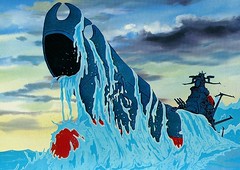
Reason Number One Why '70s Sci-Fi will Never Die

This may be the most incredible thing I have ever seen in a Science Fiction Show:


Saturday, November 1, 2008

Tuesday, October 28, 2008

Cassandra

At work, I always feel like Cassandra.  I am warning of impending doom, but no one is listening to me.  Am I crazy?  Or am I visionary.  It is hard to know.


My opinion of software is that one should always strive to release only the best possible version of software, even at the expense of being late to the market.  If you release a crappy application before your competitor, but their application is better, you will have a ton of people switching off of your platform onto the other's, and the cost of re-acquisition is going to be way higher.  If people would just stretch out their release dates and make it super easy to use, people would instead switch from the competition.  I have seen this first hand, and I won't make the former mistake again.

Monday, August 25, 2008

Fly Me To The Moon 3D - Kid Review

This weekend, we went to see Fly Me To The Moon 3D. It was really cool. I was a little worried about my kids seeing it, since every kids movie seems to have name calling, scatological references, and violence. I can barely trust the "G" rating. But this movie was fantastic. The 3D effects were surprisingly realistic. My 1 1/2 year old son kept reaching out to touch the bugs who seemed to truly hover over the audience.

As for the science, it was quite realistic. It was clear that they wanted to truthfully depict the events of the moon launch.  The lander was very real, the maneuvers the crew did to complete the journey to the moon were as they were.  The dialog, etc... weren't fantastic for an adult, but if you could put yourself in the position of a 5 year old kid, it was wildly entertaining.


One thing I do have to say was I found the depiction of the agents of the old Soviet Union to be a bit offensive.  I understand that the writers of the movie were trying to capture the environment of the late '60s, and that most of the cartoons, etc... were like that, Russian goons, etc... but the truth of it was that the Russian operatives were at least as smart and capable as our own, if not better.  I think that even for a kids movie, they could have been depicted as a little more savvy and less savage.  That required a little bit of explaining on my part to my children.

All in all, I would heartily recommend watching this movie with your kids.  I wouldn't recommend, if you watch it on DVD, just plopping them down in front of it.  Although I am not sure if the Dolby glasses will be available with the DVD, I hope they are, with my projector, I could probably reproduce most, if not all of the experience.

I had been wondering what Dolby had been doing for the past few years, and I'm glad to see them taking a more active role in advancing video as they had done for audio.

Friday, June 6, 2008

Friday, May 9, 2008

This is How you Know the Democratic Race is Over

I don't understand how a politician thinks they can get away with this crap. Bill Clinton hinted at something like that with his Jesse Jackson crack when discussing South Carolina. Now Hillary lets fly with racist crap. Like all European Americans vote strictly along race lines, not that there has been much choice up until now, but really give the average American some credit. I think what she is actually trying to say is that the average American is so unintelligent that they can only pick a candidate that is the same color as they are. What era is she living in? I don't know that I could even vote for her if she won after a statement like that.


http://thecaucus.blogs.nytimes.com/2008/05/08/clinton-touts-white-support/index.html?hp

The Glass Harmonica is the freakiest instrument known to man

Just listen, it makes you feel all weird inside:

Thursday, April 24, 2008

Buck is Back!


Jamie Lee Curtis and Erin Gray, what more could one ask for

Saturday, February 2, 2008

Mac OS X 10.5.1 Slow on Intel Macs

So, the Intel Core 2 Duo CPUs, and the new architecture are supposed to be so much faster and better than the old Power PC G5s.  I am still not sure, what I am seeing, at least with my MacBook 2 GHz, 2 GB of RAM as compared with my iMac G5 2 GHz, 2 GB RAM.


Leopard is far faster, and seemingly more stable on the G5.  The only thing I can think of is that the OS isn't optimized for the Intel chips, meaning the SIMD extensions.  Apple has had years of optimizing their code / compilers for AltiVec.  I know what the benchmarks say, and I know how the machine performs with Windows.  Leopard is definitely slower.  I guess I'll have to wait until x.5.2 comes out, hopefully we'll see some performance gains.

The other thing is that looking at the TDP of Intel's new chips, I don't really see the huge energy savings over Motorola's chips.  It looks like at 3.2 GHz they are as bad as the old P4 Extreme Edition chips.  I'm beginning to wonder what the real motivation was behind the switch, probably profit. 

Saturday, January 19, 2008

Easton Velomax Vista SL Wheelset Sucks

So a few posts ago I talked about the Tirreno Razza 900 bike I got from Performance. I still love my bike, everything is great, except for the wheels. Now I know that I am 250 lbs, and I know that I ride a minimum of 75 miles a week. I ride hard. All of these thing shouldn't matter for a good aluminum wheelset.

So what happened? It all started a few months ago. I was riding to work and I hear this loud noise.  I figured I had just rolled over a rock and it plinked off my frame.  No biggie, just a little chipped paint.   But then I heard a sound like plinko, the spoke had broken.  These are beefy looking spokes, but the nipples are not double butted, that doesn't matter.  The spoke had broken about 10 mm above the nipple.  Not at the bend, and not in the middle.  I took it in, the guys at Performance were great, they suggested that maybe there was a defect in one of the spokes.  OK I thought, stuff happens.  They replaced the spoke and off I went.


Two days ago, I was riding home from work, this time I was on totally smooth pavement, the plinko game in my back wheel started up again.  I just knew it was the replacement spoke.  What are the odds of multiple spokes breaking?  But just as I had hoped it wasn't, another spoke had popped.  I had been told several times by friends that the Mavic Open Pro wheels are the best for hard riders, so when I took the bike back to Performance again, I bought a new wheelset.  I'm still waiting for it to come in, but I'll post about it when I get it.

The problem?  I have a pair of 5 or 6 year old Ritchey DS Pro wheels on the Specialized I bought from a friend a few years ago.  I rode that bike hard before I got this one.  I have never broken a spoke.  I bought a vintage Italian steel bike, I rode that pretty hard before it got stolen, I never broke a spoke.  I bought a pair of Mavic Kyserium (sp?) wheels for my mountain bike and the spokes have never broken.  Even the cheap wheels that I replaced with the Mavics never broke, came out of true, sure.  But popped spokes, never.

Basically that wheelset sucks.  I'm looking forward to riding the open pros.

Thursday, January 3, 2008

Wednesday, December 26, 2007

Climbing on control rods... Manly!

Following onto the idea of personal reactors, this is really crazy... These guys have a strong sense of personal duty, and are quite insane:

Tuesday, December 25, 2007

A personal nuclear reactor? Not so fast!

Toshiba proposes to build nuclear reactors so small and reliable that they could be used by neighborhoods, individual commercial buildings, or even the personal homes of the wealthy. But do the numbers really work out?I think this sounds awesome! I definitely would sign up to get one of these! One of the best things the DOE (Department of Energy) could do is to diversify the grid such that every home generated its own power, and sold back unused power to the grid. That way there is no central point at which you could take out the nation's power.

read more | digg story

Monday, December 17, 2007

Joost Just Might Get Me to Watch the NBA Again

If they keep up the games on Joost, I'll probably become an NBA fan again.  Especially with the bungling of the use of technology by the NFL.  I really respect the NBA for trying something new, and I love it.


Sunday, November 25, 2007

The Definitive Hip-Hop Collection (Part 6)

26. The Roots - Do You Want More

This album dropped like a slap upside the head. Distortion to Static was the perfect single to drop first. If they had pushed Datskat out first, it would have earned them the wrong audience.

The organic feel to the album, mainly due to Qwestlove's rhythms and the group's insistence on using only normal musical instruments, gives this album a live feel, even though it is studio album. The Roots always stand out.

27. MF Doom - Special Herbs 1 & 2

MF Doom clearly spends the most time of any hip-hop artist in the "lab." He finds the most obscure jazz loops and works them into beats that are sugary treats. I still have yet to find anyone who can make a beat like Doom. I am not certain what his relationship with Madlib is, but they are very similar in style.

Special Herbs is an album that belongs in any discerning hip-hop listener's collection.

28. Del the Funkee Homosapien - No Need For Alarm

Del is funkee, simply because he was Kanye West, a decade before Kanye West. When he came out, he was just Del. There was no bling, no talking about ho's, money, cars, etc... His beats were eclectic and his lyrics were strong. No Need For Alarm is an important contribution to hip-hop.

29. Dan the Automator / Dr. Octagon / Kool Keith - Dr. Octagonecologyst

It is hard to determine who Octagon is. His flow is stream of consciousness so he isn't for everybody. He hasn't really changed since he was with Ultramagnetic, and they were sick back in the day. Keith is still crazy, but Dr. Octagonecologyst was his best album.

30. Souls of Mischief - 93' til Infinity

This album is good, but not great, still it was one of the first albums from the Bay Area to achieve mainstream success. Digital Underground's albums were the first. That's When You're Lost was one of my favorite songs for years.

That round out my list. I believe that if you get all of these albums, you will have a good understanding of where Hip-Hop is today, and where it has come from.

The Definitive Hip-Hop Collection (Part 5)

21. 50 Cent - Get Rich or Die Tryin'

This album is probably the most raw, and ostensibly the most disarming album to be released since Wu-Tang released Enter the 36 Chambers. What 50 does in this album is let everyone know how hungry he is for success, as well as attention. His constant beef with just about every other rapper is evidence of that. I am not sure where Eminem found 50, but by putting him on, we are all eternally grateful.

22. Eminem - The Slim Shady LP

Eminem is far and away the best lyricist that is currently on. In a battle, he will destroy any rapper that approaches. On I Still Don't Give A F**k he delivers one of the best put-together flows I have ever heard.

The basic problem is the same one that happens to most anyone else who is successful and has no real competition. They get lazy and release basically garbage. As a result this album stands as, lyrically, probably the best album on the list.

23. 2-Pac - Strictly for my N.I.G.G.A.Z.

2-Pac has to be one of the most prolific hip-hop artists ever. I'm sure the number of songs he has written number in the thousands. However, with all of that volume, there have only been a few quality albums. This was his best. The title track sounds like warfare, and he doesn't stop there.

Every song on this album would be a single on any other hip-hop artist of the era's albums. The only song that is out of place is I Get Around with Digital Underground. The song is a little too playful for the album, but is still an outstanding track.

24. Ghostface Killah - Ironman

Ghostface Killah is my favorite rapper, and that bias should be known, but his lyrics are insane, he can deliver fast, he can deliver slow, basically if you have a garbage track you can throw him on it and he will save the track.

If there is a problem with Ironman, it is too much of a good thing. Many of the gems Ghostface drops are lost in the flow of the album, and the RZA's hard beats. The Pretty Tony album and Fishscale should get honorable mention.

25. Digable Planets - Blowout Comb

Blowout Comb was a very moody album, and a departure from Digable Planets' mainstream style. I get the impression from listening to it that the success of Reachin' made them uncomfortable, and they wanted to go back to their revolutionary roots.

Many would probably wonder why I didn't put Reachin' on the list, but I think that artistically, Blowout Comb is a superior effort

Tuesday, November 13, 2007

How Dare the U.S. Congress Call Yahoo, Google, and Microsoft on Morality In China - A Rant

Talk about the pot calling the kettle black.  This is obscene, this Congress, this rubber stamp Congress, has absolutely no grounds for blaming Yahoo for their behavior in China.  This is the most hypocritical action by a congress in my lifetime. 

They are the ones who don't apply tariffs on goods and services from China.  They are the ones who look the other way when the Chinese government slaughters students to keep doing business with them.  They are the ones who keep "good trade partner" status with China while they force people to work 18 hour days on dangerous machines and allow poisonous foods into the country.

If the U.S. Government wants to take a stand on China, they should sanction them, and levy hefty tariffs on goods and services from China to pay for us screening every item until they improve the quality of the goods they are shipping into our country, and not remove the sanctions until they improve their human rights record.

Or perhaps, if they really want to do something, instead of just passing whatever garbage the President wants to introduce, they could actually help hold them accountable for destroying our right to protection from unwarranted search and seizure by allowing cases against AT&T, Sprint, and the like.  It is the only way to challenge the constitutionality of those provisions of the USA Patriot Act.

Yahoo, Google, and Microsoft have only one responsibility as corporations, and that is to the board and the shareholders.  If Yahoo had not turned over the information about the journalist, they wouldn't have been able to do business in China, it wouldn't have been acting in the best interest of its shareholders and wouldn't have been being a good corporate citizen.  Morally, obviously they shouldn't have done it, but it is the U.S. Government's fault for making it so lucrative to do business with an immoral and repressive regime.

How can you expect for a business to not try to make money.  It is the government's responsibility to provide oversight, and to structure policies as to ensure the best behavior of the corporate world, not complain about it after the fact.  How can they say that it is OK to do business with them out of one side of their mouths, and then say that if you do, we are going to publicly embarrass you?  That doesn't even make any sense.

All the government has done is what they always do, screw up the market, screw up the economy and make themselves an obstacle to peace and goodwill in the world.  I certainly hope that in the upcoming elections we make a statement against this type of boneheaded posturing by politicians.

Blogged with Flock